
17-4 PH Stainless Steel
1.4542 (17-4 PH)
- EN1.4542
- ENX5CrNiCuNb16-4
- AISI630
- UNSS17400
- Ticari17-4 PH
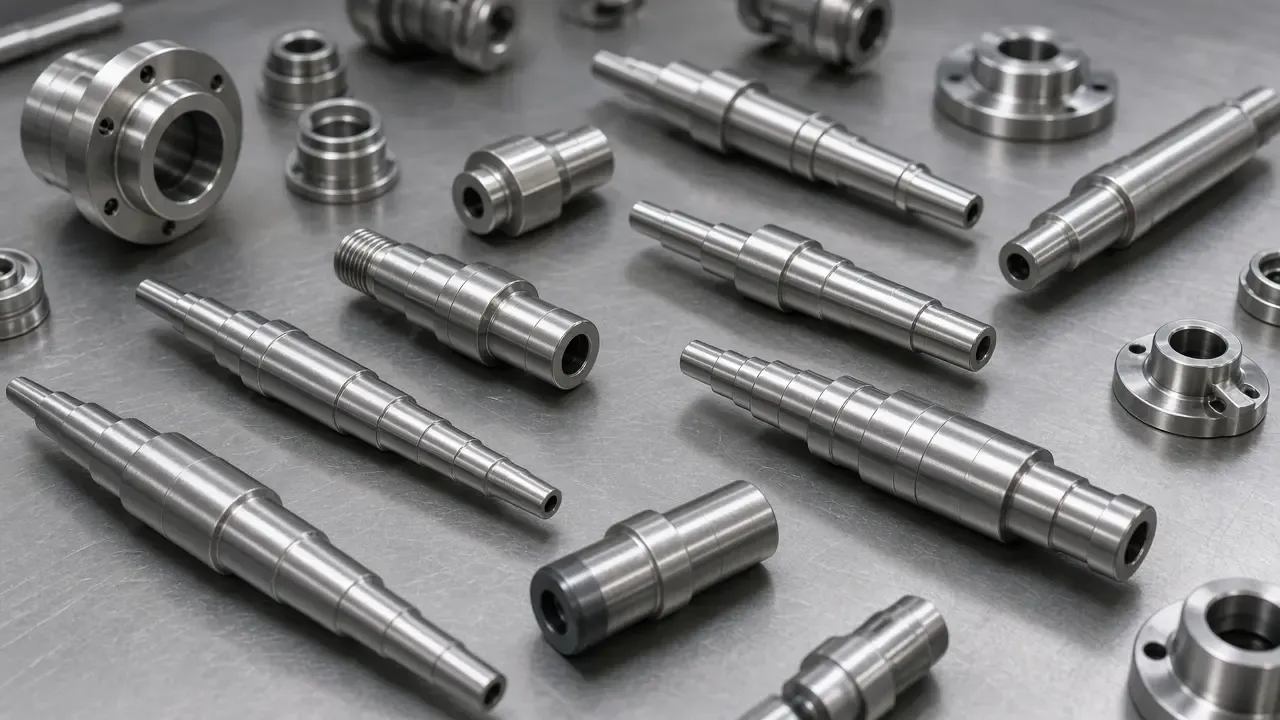
Chromium-nickel-copper precipitation-hardening (PH) stainless steel with niobium; delivery hardness is 28–44 HRC. Used for pump and valve shafts, hydraulic cylinders and parts in contact with seawater where strength must come with corrosion resistance.
Spectral Analysis
wt. % · EN 10088-3 ranges- C
- ≤0.07
- Si
- ≤0.70
- Mn
- ≤1.50
- Cr
- 15.0–17.0
- Ni
- 3.00–5.00
- Cu
- 3.00–5.00
- Nb
- 5×C–0.45
Typical ranges according to the standard, for information only. The analysis on the material certificate applies on delivery.
01Applications
- Sectors with demanding service conditions such as aerospace and oil and gas
- Jet engines
- Hydraulic cylinders
- Pump and valve shafts
- Seawater-exposed parts of ships and submarines
- Chemical plants
- Kitchen equipment
02Delivery Condition
- 28–44 HRC
03Heat Treatment
Heat Treatment Steps
Ageing Diagram
Values are approximate and for information only; they vary with section size, heat and furnace conditions. Binding values are determined from the manufacturer’s data under laboratory conditions.
04Mechanical Properties
Minimum values to ASTM A564 in the aged conditions (bar); the solution-treated (A) condition has a hardness limit only. As the ageing temperature rises, strength decreases while ductility and toughness increase.
| Condition | Ageing | Rm min. (MPa) | Rp0.2 min. (MPa) | A min. (%) | Hardness (HRC) |
|---|---|---|---|---|---|
| Solution treated (A) | 1020–1060 °C, rapid cooling | — | — | — | Max. 38 |
| H900 | 482 °C, 1 h | 1310 | 1170 | 10 | Min. 40 |
| H925 | 496 °C, 4 h | 1170 | 1070 | 10 | Min. 38 |
| H1025 | 552 °C, 4 h | 1070 | 1000 | 12 | Min. 35 |
| H1075 | 580 °C, 4 h | 1000 | 860 | 13 | Min. 32 |
| H1150 | 621 °C, 4 h | 930 | 725 | 16 | Min. 28 |
Values are ASTM A564 Type 630 minimums; additional requirements (e.g. reduction of area, impact) may apply by section and product form. For EN 10088-3 orders, the values of the relevant +P condition apply. The applicable specification and material certificate govern for orders.
05Applicable Standards & Specifications
- ASTM A564 — Hot-rolled and cold-finished age-hardening stainless steel bars (Type 630)
- ASTM A693 — Precipitation-hardening stainless plate, sheet and strip (Type 630)
- ASTM A705 — Age-hardening stainless steel forgings (Type 630)
- EN 10088-3 — Stainless steel bars and sections (1.4542, X5CrNiCuNb16-4)
- AMS 5643 — 17-4 PH bars and forgings (aerospace, on request)
- AMS 2759/3 — Heat treatment of precipitation-hardening corrosion-resistant steels
- NACE MR0175 / ISO 15156-3 — Sour service; limited use in the double H1150 condition (on request)
A product specification and an inspection document are different things: e.g. AMS 4928 is a product specification, EN 10204 3.1 is a type of inspection document; one does not replace the other.
06Microstructure & Metallurgical Properties
Typical microstructure information17-4 PH is a low-carbon martensitic precipitation-hardening stainless steel. In the solution-treated condition it consists of lath martensite supersaturated with copper; strength is developed by fine copper-rich particles that precipitate during ageing.
Typical metallurgical characteristics
- Low-carbon lath martensite matrix
- Hardening by fine copper-rich precipitates
- Strength–toughness balance set by ageing temperature
- Limited delta ferrite possible, depending on chemical balance
- Carbon tied up as NbC
- 1.Typical microstructure
- Solution treated (A): lath martensite. Aged conditions: finely dispersed copper-rich precipitates in a martensitic matrix. Depending on the chemical balance, a small amount of delta ferrite (usually elongated in the rolling direction) may be present.
- 2.Heat treatment influence
- In H900 the precipitates are very fine and dense, giving the highest strength and hardness and the lowest toughness. In H1025 the precipitates coarsen and strength is balanced with toughness. In H1150, overaged coarse precipitates and some reverted austenite raise toughness and stress-corrosion resistance. Solution-treated and aged 1.4542 do not show the same microstructure.
- 3.Grain structure
- Prior austenite grain size depends on solution treatment temperature and time; martensite forms as packets and laths within these grains.
- 4.Carbide / precipitate distribution
- Copper-rich (ε-Cu) precipitates on ageing; niobium carbides (NbC) tie up carbon and limit chromium carbide formation. Reverted austenite may form at higher ageing temperatures.
- 5.Metallographic examination
- Batch-specific metallographic examination is available upon request. A microstructure image alone does not prove chemical analysis, mechanical properties or certificate compliance.
Available technical documentation
- Chemical composition certificate
- Mechanical test report, where available
- Heat treatment information, where available
- Metallographic examination, upon request
Typical microstructure information. Actual microstructure may vary depending on manufacturing route, product form and heat treatment.
07Is there a better material?
Grades in the same material family as 17-4 PH with higher wear resistance and higher impact resistance (toughness); up to two suggestions under each heading. Which one fits depends on the application's priority requirement.
Higher wear resistance
- 420 Stainless Steel
Wear resistance: Low → Medium
Trade-off: Strength, Corrosion resistance
- 420 (X30Cr13) Martensitic Stainless Steel
Wear resistance: Low → Medium
Trade-off: Toughness
Higher impact resistance (toughness)
- 15-5 PH Stainless Steel
Toughness: Medium → High
- PH 13-8 Mo Stainless Steel
Toughness: Medium → High
Suggestions are based on the critical property levels in our grade data; an improvement in one property may require a trade-off in another. The final selection must be made by technical evaluation against operating conditions, heat treatment and specification.
For more information, browse our Technical Insights08Move Metal Supply Options
Move Metal is not a producer; we source the grade to your specification through our international producer and supplier network. Dimensions, quantity, delivery condition and documentation requirements are reviewed together.
Product forms
- Round bar
- Flat bar
- Plate
- Sheet
- Forgings
- Cut-to-size
Documents and testing
- EN 10204 3.1 inspection certificate
- EN 10204 3.2 inspection certificate (upon request, third party)
- Ultrasonic testing (e.g. EN 10308, ASTM A388), upon request
- Intergranular corrosion testing (e.g. ASTM A262, EN ISO 3651-2)
- Detrimental phase testing for duplex steels (ASTM A923)
Not sure if 17-4 PH is the right material for your application?
Evaluate candidate materials by application, operating conditions and priority properties with the Material Selection Guide.
Find the Right MaterialTechnical resources for this material
- 17-4 PH Stainless Steel Guide: Properties, Heat-Treatment Conditions and Specifications
- PH Stainless Steels: How 17-4PH, 15-5PH and 13-8PH Differ
- Why Can the Same Grade Behave Differently in Different Delivery Conditions?
- Is an “Equivalent” Material Really Equivalent?
- Compare 17-4 PH with 15-5 PH
- Material Selection Guide
Have a material requirement?
Send us your specification, drawing or RFQ. Our team will review the requirement and identify a suitable supply option.