
Why Do Dimensional Changes Occur After Heat Treatment?
During hardening and tempering, microstructural transformations and stresses can cause dimensional change and distortion. We summarise the main causes and the measures that can be taken at design and sourcing stage.
Published: Move Metal
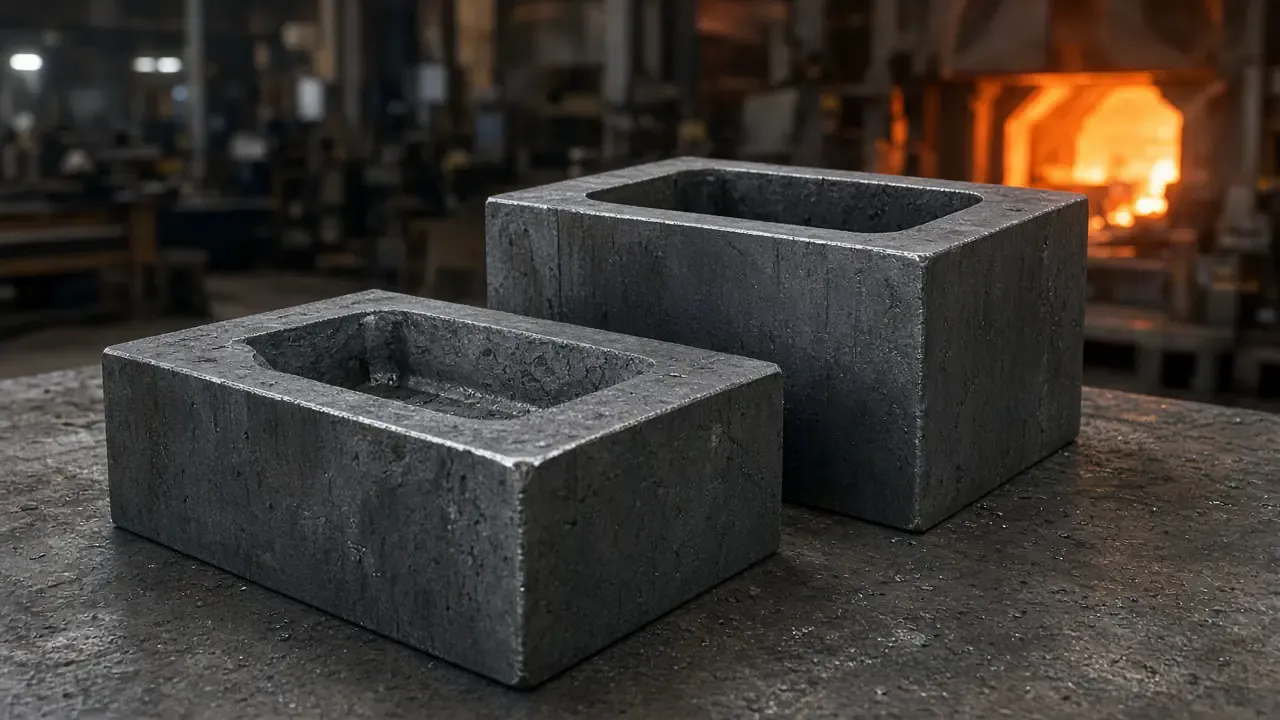
Dimensional change or distortion after heat treatment is often not a defect but the natural behaviour of the material. It is possible to anticipate and manage this behaviour.
Main causes
- Microstructural transformations: The structures formed on hardening have a different volume from the annealed structure. This can cause growth or shrinkage.
- Retained austenite: Structure that remains untransformed after hardening can transform during tempering or over time and cause dimensional change.
- Thermal stresses: In parts with varying sections, thin and thick areas heat up and cool down at different rates.
- Residual stresses from earlier operations: Stresses from machining, welding or straightening can be released during heat treatment.
- Directionality of the material: Depending on the rolling or forging direction, dimensional change may differ by direction.
Effect of material selection
Some grades show lower distortion in heat treatment. For example, air-hardening cold-work steels generally tend to distort less than those requiring rapid quenching. Surface treatments applied at low temperature, such as nitriding, can also be applied with more limited dimensional change. Grade selection should be evaluated together with the part geometry and the dimensional tolerance.
Measures that can be taken
- Apply stress relieving after rough machining
- Leave sufficient machining and grinding allowance for heat treatment
- Avoid sharp corners and abrupt section changes
- Select heat treatment parameters for the material and section
- For critical parts, machine to final size after heat treatment
Conclusion
Dimensional change cannot be eliminated entirely, but it can be managed with the right grade, a suitable machining sequence and controlled heat treatment. For parts with critical tolerances, material and heat treatment should be planned together.