
Why Does ESR Matter for 1.2344?
1.2344 with the same chemical composition can have different internal cleanliness depending on whether it is produced conventionally or by ESR. We summarise when an ESR requirement is meaningful and how to state it in an order.
Published: Move Metal
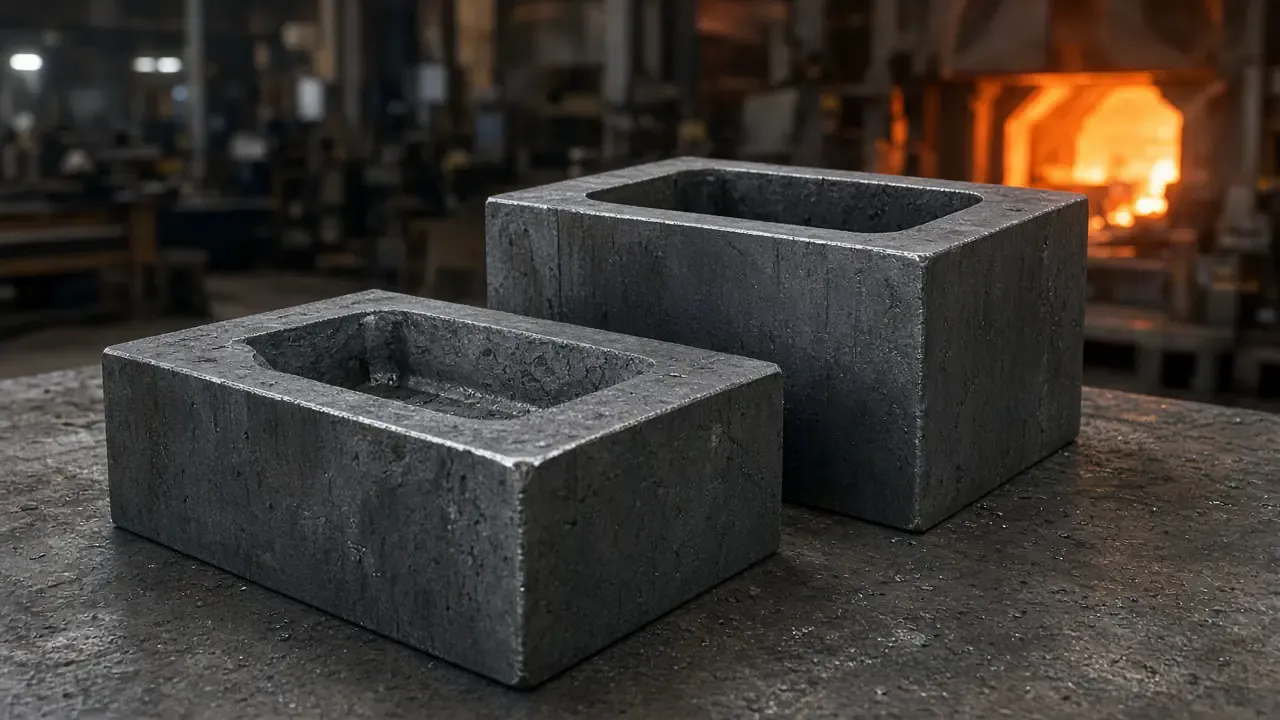
1.2344 (X40CrMoV5-1, AISI H13) can be produced both by conventional melting and by ESR (electroslag remelting). The standard chemical composition may stay the same; the difference lies in the cleanliness and homogeneity of the internal structure.
What does ESR change?
In the ESR process, a pre-made electrode is remelted through a liquid slag bath and solidified under control. The aim of this approach is to:
- reduce non-metallic inclusions,
- limit segregation,
- achieve a more homogeneous internal structure across the section.
In which applications does it become important?
Internal cleanliness becomes more decisive as the operating conditions of the die become more demanding:
- Dies dominated by thermal fatigue: In die casting and forging dies, repeated heating and cooling cycles can promote crack initiation around inclusions.
- High polishing requirements: In plastic mould applications, inclusions can appear as marks on the surface.
- Large sections: As the section grows, the homogeneity of the internal structure and the core properties matter more.
In lower-stress applications with a shorter expected life, conventional quality may be sufficient. The decision should be based on the operating conditions of the die and the expected life.
How should it be stated in an order?
Writing “1.2344” does not define an ESR requirement. The request should clearly include:
- Production route: ESR
- Delivery condition: soft annealed or hardened
- Size, tolerance and quantity
- Required inspections (e.g. ultrasonic testing and acceptance class)
- Certificate type (e.g. EN 10204 3.1)
Conclusion
ESR targets the internal quality of 1.2344, not its chemistry. Whether an application needs ESR should be decided by evaluating die type, operating temperature, expected life and cost together. You can share the die type and operating conditions in your technical request for evaluation.